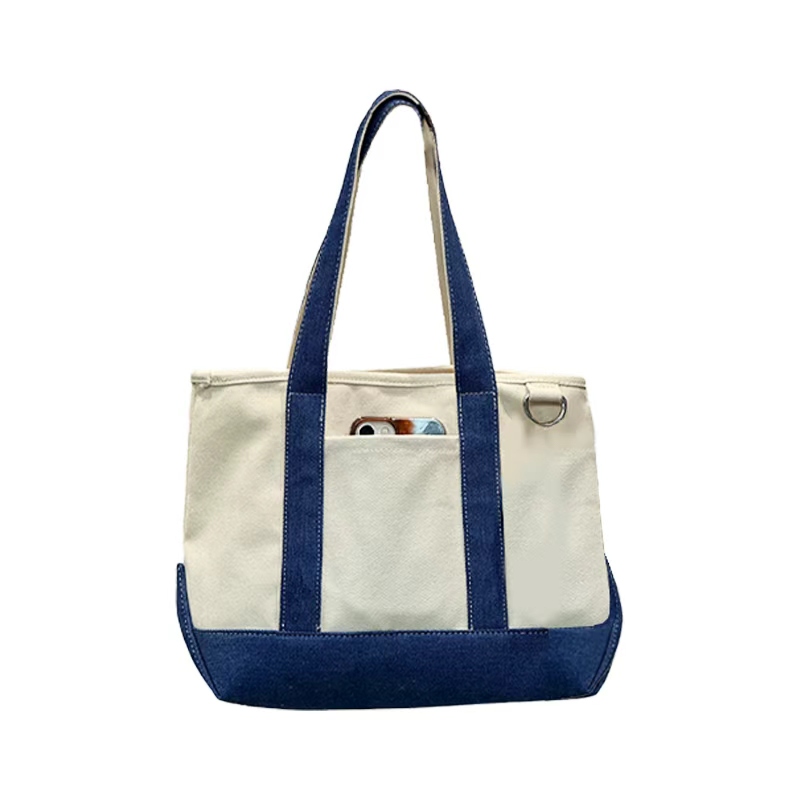
A customer should not have to empty a tote to reach a travel card. An outside pocket may solve that problem, but it also becomes part of the printed front, the handle layout and the way the bag sits against clothing.
Plan cotton tote exterior pockets on the actual bag drawing before approving a large logo. Moving the print afterwards can be a poor compromise when the pocket was never given a defined position or purpose.
The Gahumi photograph is a visual reference, not confirmation of a particular pocket construction. Finished pocket dimensions and availability need project review.
Choose what belongs outside
List what the user is meant to reach without opening the main compartment. A folded leaflet, phone in its case and drinks bottle need different shapes. Consider whether the item should remain partly visible and how the pocket will be used while the tote is carried.
The Heavy Pocket Tote from Take It Easy Lab in Leeds is a current example of cotton canvas with several external pockets. The useful design lesson is that outside organisation can be planned into the bag; its pocket count does not establish what your customers need.
Does an outside tote pocket need a closure? That depends on the stated purpose and the access you want. An open pocket can be convenient, but it is not a security feature. If a closure is requested, identify that separate construction and assess its operation rather than describing an open compartment as secure.
Draw the pocket and the print together
A cotton tote pocket and print layout should identify the finished pocket edges, opening, handle straps and artwork on one view. Show whether the design stops above the pocket, sits on it or crosses a join. Ask the decorator to confirm what can be reproduced on the proposed construction.
Check the pocket’s own print orientation with an item inside. An illustration that appears flat in a mock-up can change when the compartment is filled. If artwork spans several surfaces, ask for a physical decorated sample; a rectangle on a digital drawing cannot show every fold.
Use the artwork and placement guide for the print file itself. For the sewn pocket, mark usable width, depth and opening separately from the outer panel dimensions.
The outside view is only half the review
An exterior patch pocket attachment may be visible inside an unlined bag. Ask how the proposed seams are finished and whether stitching crosses a requested inner compartment. Review an inside photograph or the physical sample, not just the customer-facing surface.
What should a buyer put in an outside pocket sample? Use the intended object with its normal case or packaging, then fill the main bag as planned. Remove and replace the object while the tote is set down and while it is carried. Note whether the pocket mouth is covered by a strap or drawn tight by the contents.
For a side pocket, photograph access from the wearer’s position. For a front pocket, check the area against the body and the position of the logo. Record the observations without claiming the design suits every person or prevents loss.
If the requested purpose is better served inside the tote, return to the inside-pocket brief. Adding both versions is not automatically an improvement.
Leave fewer choices hidden in the order
An outside pocket sampling brief should include the object, placement drawing, finished dimensions, proposed fabric, decoration and any closure. Ask which parts affect construction, price or sample development. Identify the final pocket count rather than leaving it implied by a reference photograph.
A cotton requirement still needs clear boundaries
Specify the reusable cotton-canvas body and pocket fabrics independently. If both must be 100% cotton, request confirmation of both; labels, thread and fittings still need their own descriptions. Extra fabric is not evidence of an environmental benefit.
Send the complete layout, quantity and delivery country to Gahumi for a feasibility discussion. The pocket and the printed bag should be quoted as the same accepted design.
Email your pocket drawing to gzgahumibag@gmail.com.