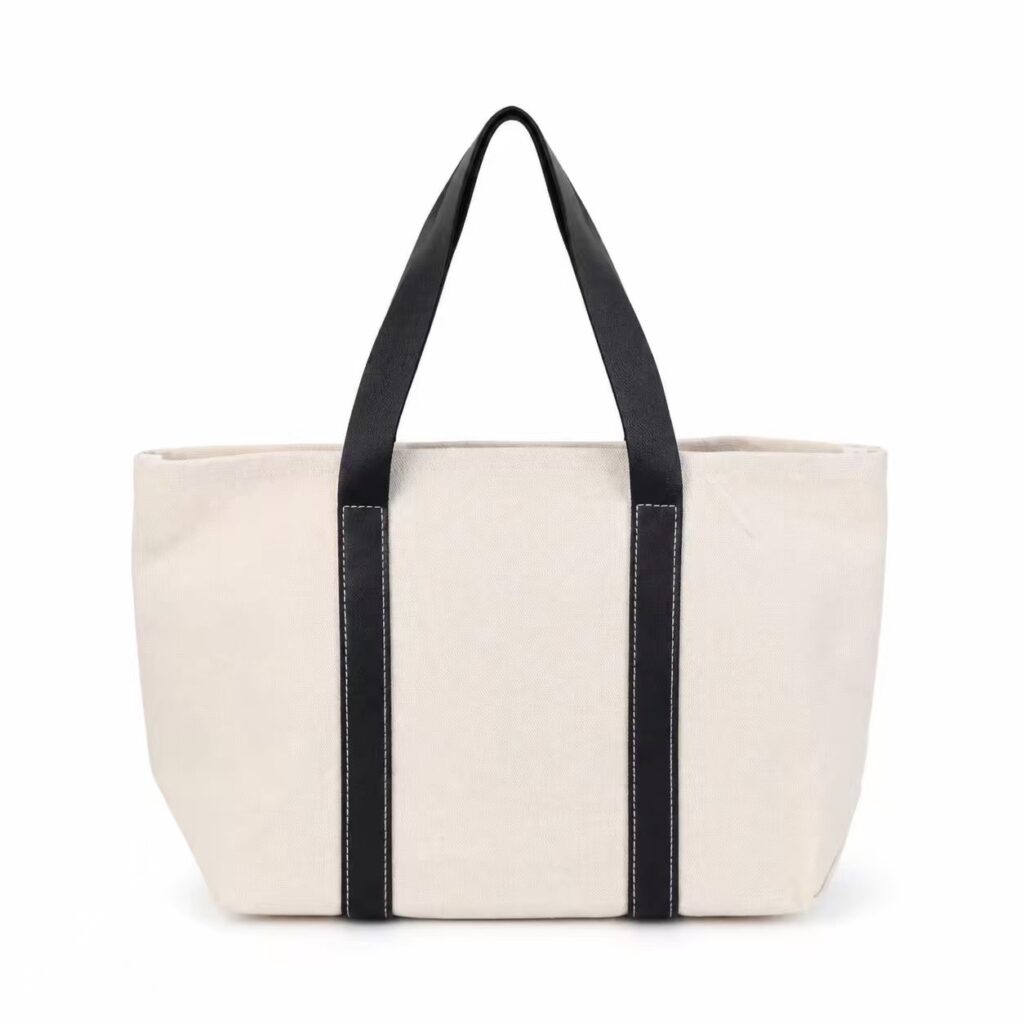
A natural-colour canvas body with contrasting black handles gives a tote bag a distinctive look while keeping the design easy to use every day. The broad fabric panels leave room for a printed logo, and the sewn straps add a visible construction detail. For brands ordering custom cotton canvas bags, this combination offers a useful starting point for a reusable shopping bag, retail tote or customer gift.
Choosing the right bag means looking beyond its photograph. Cotton content, fabric weight, handle attachment, colour matching and sample approval all affect the finished product. This guide explains how to specify a custom 100% cotton canvas tote with a two-tone design and a practical approach to environmental responsibility.
What Is a Two-Tone Cotton Canvas Bag?
A two-tone canvas bag combines contrasting colours within its construction. A natural-colour body with black cotton handles is one example. Other designs can use navy straps, a contrasting bottom panel or different-coloured side panels, depending on the specification.
In a style with straps sewn down the outer panels, the handles become part of the bag’s appearance. Their width, spacing and alignment influence both the visual balance and the space available for branding. The contrast comes from separate fabric components, while the logo can be printed or embroidered onto the canvas.
For a 100% cotton version, specify cotton canvas for the body and cotton for the contrasting fabric or webbing. Confirm the composition of each component rather than assuming that every part of a cotton canvas bag is made from cotton.
Plan for repeated use and accurate material claims
A canvas bag supports a reusable-bag programme when people find it comfortable, useful and worth keeping. A suitable size, secure handles and a design that fits everyday routines give the bag a practical reason to be used again.
Cotton cultivation and bag production also require resources. The environmental comparison with another bag depends on production, what the tote replaces and how often it is reused. The UK Environment Agency’s carrier-bag life-cycle assessment identifies reuse as an important factor in reducing impacts. Its results are specific to the bags and assumptions studied, rather than a performance guarantee for every canvas tote.
For a custom two-tone bag, put this approach into the product specification: choose a fabric suited to its intended contents, reinforce stressed connections, and include care instructions appropriate to the finished bag. Order a quantity linked to expected demand and consider whether individual packaging is necessary.
Describe the resulting product with facts you can support, such as its cotton composition and reusable design. Claims about organic content, recycled content or environmental savings need evidence for the particular bag.
Choose the Cotton Canvas and Fabric Weight
Canvas describes a fabric construction; it does not establish the fibre content. Request a clear material specification for the body, handles, contrasting panels and any lining. If these textile components must be 100% cotton, state that requirement before sampling. Sewing thread, labels and other trims should also be identified separately.
Fabric weight is usually expressed in grams per square metre, or GSM. It helps compare the feel and substance of candidate fabrics. The following ranges are illustrative starting points, not standard performance grades or carrying-capacity ratings.
| Approximate fabric weight | What to compare | Sample question |
|---|---|---|
| 170–220 GSM | Fold, coverage and hand feel | Does the sample hold the intended contents and pack as required? |
| 240–340 GSM | Finished shape and decoration | Do handles, panel shape and print work together in the assembled bag? |
| 360–500 GSM | Seam bulk, fold and total weight | Is the extra fabric mass useful for this brief, rather than an assumed quality grade? |
For a natural-and-black design, compare the canvas with the actual handle webbing. A very heavy strap on a light body may feel unbalanced. Weave, finishing and stitching also affect the bag’s behaviour, so assess a finished sample rather than selecting on GSM alone.
Ordinary cotton, organic cotton and recycled cotton are different specifications. If you request an organic or recycled version, confirm availability, actual fibre percentages and supporting documentation. A recycled-cotton fabric can contain other fibres and should not automatically be described as 100% cotton.
For more detail, see our canvas weight guide.
Specify the Bag Size and Sewn Construction
Start with what the canvas bag needs to hold. A retail tote should accommodate the intended products without unnecessary bulk. A daily-use tote needs a comfortable opening and enough capacity for its usual contents.
Record width, height and depth separately. If the design includes a bottom gusset, confirm its dimensions and the finished shape. A gusset can provide more room for bulky contents, but the photograph alone will not establish usable capacity or how the bag stands when filled.
For contrasting handles, specify the webbing width and the handle drop: the distance from the bag opening to the top of the handle. Handle drop is more useful for checking shoulder comfort than total strap length alone.
Where straps run down the outer panels, inspect their alignment and stitching along the attachment. Discuss reinforcement at the opening and other stressed points. Extra strap length can provide more attachment area, but strength still depends on the fabric, sewing and overall construction.
Check the inside seam finish, bottom corners and opening on the sample. Assess it with representative contents, and agree any load-testing requirement before approving production.
Develop the Body and Handle Colour Combination
A natural-colour canvas body with black straps creates a clear contrast and leaves a light surface for branding. Navy, forest green or another brand colour can produce a different appearance, subject to suitable fabric and webbing availability.
Specify the body colour, handle colour and logo colour separately. The same colour reference can look different on canvas, woven webbing and printing ink because the materials and processes differ.
Use Pantone references or a physical colour standard to communicate the target, then approve actual swatches. For custom-dyed fabric, discuss a lab dip, which is a small dyed sample. For the logo, request a print sample on the intended canvas when colour accuracy matters.
On a light body with dark handles, also check whether the handle colour transfers during rubbing or the intended cleaning process. Sewn colour contrast is a construction feature; dyed fabrics can still change colour with wear, washing and exposure.
Place the Logo Around the Contrasting Straps
The open canvas area between the straps is a natural place for a logo. Confirm the printable width and height after the strap positions are fixed. A logo that fits the flat artwork may sit too close to a strap or disappear behind the bag’s folds when carried.
Screen printing can suit bold logos with a limited number of colours. Transfer printing can suit detailed or multicolour artwork, while embroidery adds a textured finish. The appropriate method depends on the canvas surface, artwork, quantity and required care performance. Confirm availability for the particular bag rather than assuming that every listed process can be supplied.
Avoid assuming that one method is always the most durable or environmentally preferable. Review its appearance and suitability on a sample, including any backing or transfer film used.
Provide the final logo dimensions and its position relative to the bag opening and straps. Printing across raised webbing or seams needs a separate feasibility check. If you add a label, specify its material and placement alongside the rest of the bag.
Review the Finished Sample Before Bulk Production
Use the digital mockup to agree on the colour layout and logo position, then check a finished sample made to your specification. Pick it up, try the handles and fill it with the items you expect it to carry.
Before approving bulk production:
Confirm that the canvas body and handle webbing match your agreed cotton specification.
Measure the finished dimensions, gusset and handle drop. Check that the bag fits your intended contents and is comfortable to carry.
Check that the contrasting straps are straight, evenly positioned and securely sewn to the bag.
Compare the canvas, handles and logo with your approved physical colour references.
Check the logo size and position, including how it looks when the bag is filled and carried.
Inspect the inside seams, base corners and opening. Confirm that any care-test results support the agreed cleaning instructions.
Record any changes before you approve production. Keep an approved sample and the fabric and colour references so you and your supplier have the same standard for this order and future reorders.
Plan the Quantity and Delivery Around the Specification
Minimum order quantity and price depend on the construction and customisation. Existing canvas and webbing colours can require a different order quantity from specially dyed materials. Additional panels, pockets or labels also affect production work.
Ask for a quotation based on the complete bag specification. Distinguish sample preparation, material sourcing, bulk production, inspection and shipping when reviewing the schedule. A production lead time does not automatically include arrival at the destination.
Provide your required arrival date and delivery country at the start. This allows the proposed materials, approval process and shipping method to be considered together. Confirm the final timetable in the quotation rather than relying on a general lead-time estimate.
Frequently Asked Questions
Can a Two-Tone Canvas Bag Be Made from 100% Cotton?
Yes, a design can specify a cotton canvas body with cotton handles and contrasting cotton panels. Confirm the composition of these parts individually, and identify any thread, labels, lining or other trims separately.
Is Every Cotton Canvas Bag Eco-Friendly?
Cotton content alone does not prove a lower environmental impact. Useful repeated use, production choices and verified material information matter. A well-specified reusable canvas bag gives customers a practical alternative to repeatedly taking another carrier bag.
Can the Finished Canvas Bag Be Washed?
Follow care instructions confirmed for the finished bag. Cotton can shrink, and dark handles or printed artwork may react differently to cleaning. Check the intended care method on a sample before describing the bag as machine washable.
Request a Quote for Your Custom Cotton Canvas Bags
Planning a natural-and-black tote or another two-tone canvas design? Share your requirements with Gahumi to discuss materials, construction, branding and sampling for your order.
Include the quantity, bag dimensions, preferred canvas weight, body and handle colours, logo artwork, delivery country and required arrival date. If 100% cotton or an organic or recycled specification is essential, include that requirement in the brief.
Request a quote for your custom cotton canvas bags.
Request a two-tone bag quoteDiscuss body and handle options on WhatsApp
Prefer email? Send the relevant bag details to gzgahumibag@gmail.com.