Turn the sample inside out and the striped face becomes plain. The design now has a second public surface, not merely a different lining. Any exposed seam, label or pocket changes its role too.
Reversible cotton tote bags need approval in both orientations. That can be useful for a retail range with a printed and a quieter face, but the second appearance should be developed deliberately rather than promised after a lined sample has been made.
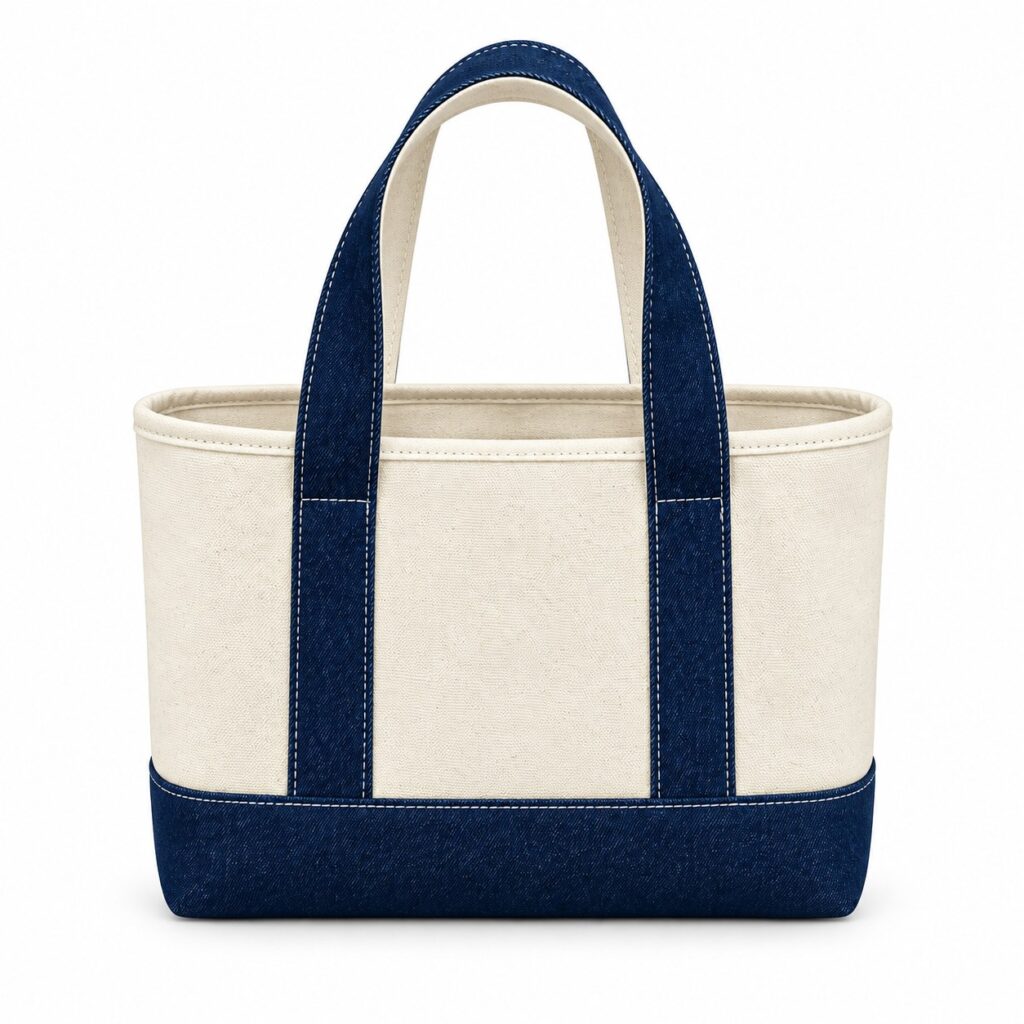
The pictured Gahumi tote shows an exterior style reference. It is not evidence of a reversible assembly; that option needs a separate feasibility review.
Reversible is not another name for lined
Is a lined cotton tote automatically reversible? No. A lining can be designed only for the inside, with its joins, labels and attachments arranged accordingly. To offer the bag both ways out, identify each intended exterior and ask the maker to assess the complete construction.
Tommy Hilfiger’s reversible cotton canvas example describes reversibility as a specific feature. The Cognitive Surplus European tote listing also distinguishes the patterned and plain orientations. Neither listing establishes Gahumi’s capability or the materials for a new order.
Start a reversible tote face map with two named views, such as printed face A and plain face B. Show the complete bag in each orientation, including the handles, opening and base. “Print both sides” would usually describe the front and back of one exterior, which is a different instruction.
Follow every detail through the turn
Imagine the product hanging on a shop hook in either orientation. Will a care or brand label face the customer? Where will a pocket be, and will its reverse attachment show? Ask these questions on the drawing before choosing the decorative finish.
Reversible cotton tote seam finishing must be assessed from both visible faces. Have the maker identify how joins and the final assembly opening would be finished. A neat outer face does not tell you how the second face will look after turning.
If a pocket is requested, record its purpose in each orientation. A compartment that moves from inside to outside changes access and exposure. It may be preferable to omit it rather than accept a feature whose second position has no useful job.
Our lined and unlined tote guide helps separate the fabric layers. It should not be used as a substitute for a reversible assembly drawing.
Try a full change rather than a staged photograph
What should a reversible tote sample review include? Empty the bag, turn it by the intended method, settle the corners and handles, then repack it. Repeat in the other direction. Note any pulling, trapped parts or rearranging that a customer would need to resolve.
Review both printed orientations with representative contents inside. Check that an illustration stays the intended way up, the top edge sits as agreed and the handles can be used without twisting a layer into the opening. Photograph the complete bag, not just the two flat panels.
A reversible tote care assessment concerns the combined fabrics and decoration. Ask which evaluation supports the proposed instructions and whether the two layers remain compatible after the agreed procedure. The finished-bag care guide keeps this separate from an untested fabric assumption.
Record both fabric references and compositions, even when both are requested as 100% cotton. Identify thread, labels and any fittings separately. Reusability and two styling options do not by themselves prove a reduced environmental impact.
Keep the face map, artwork versions, pocket decisions and accepted sample photographs together. Ask for the cost of that defined assembly rather than comparing it with an ordinary unlined tote.
Gahumi can review your proposed two-face brief, quantities and delivery country. Construction feasibility, sample scope and timing need confirmation before reversibility becomes an order requirement.
Send the same brief by email to gzgahumibag@gmail.com.