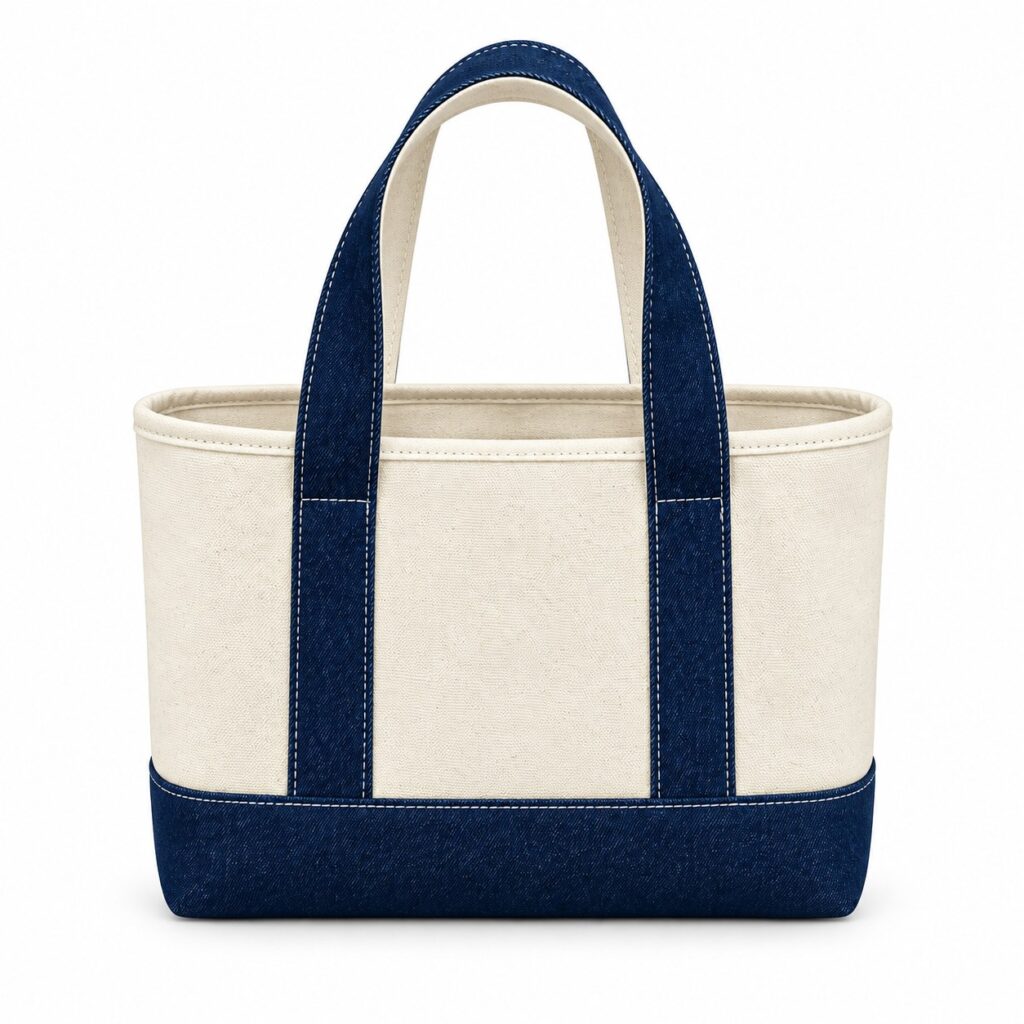
The buyer has already decided that the tote needs depth. The remaining question is how to form it. A photograph of a rectangular bottom does not reveal whether the main body is shaped at its corners or joined to an independent base piece.
Boxed corner cotton tote bags and a separate-base proposal can be compared against the same intended footprint. Ask for the actual panel layout rather than treating the word gusset as a cutting instruction.
Hold the finished requirement steady
Begin with the required usable outline, intended contents and finished measurement points. Keep the body fabric and other major features comparable so that the review answers a construction question, not a simultaneous change of cloth and size.
Does the same gusset depth identify the same construction? No. The flat and gusseted guide explains why depth needs an actual layout. Here, take that decision further by locating every panel and join around the bottom.
Read two possible layouts
A boxed-corner arrangement shapes the meeting of the body sections to form depth. Art Gallery Fabrics’ original tote example helps identify that construction family before reviewing the maker’s own panel layout for your required size.
A separate base proposal introduces an identified bottom piece joined to the surrounding parts. Ask the supplier to distinguish it from a contrast overlay added over another body construction. Two visible colour areas do not prove there are two structural panels.
Is a separate base panel a removable insert? No. A sewn bottom belongs to the fabric construction; a removable support insert is a separate item requiring its own fit and material decisions.
Make a comparison another person can inspect
Request a finished base footprint drawing with front, side and underside views. Mark the corner joins, any continuous body fold, fabric direction and changes of material. Have the maker identify how those views relate to the proposed flat pieces.
- Locate the seams across or around the bottom and show which face touches the contents.
- Identify whether the body continues through the base or ends at a join.
- Compare the filled outline and the intended empty fold.
- Keep any backing, lining or additional support visible in the specification.
Use the actual sample to examine corner shape and bulk. Check a representative package entering and leaving the bag. Where strength, stability or material use drives the decision, agree how the two actual proposals will be compared instead of inferring an advantage from the layout alone.
Choose the accepted construction, not the sales name
Cotton tote bottom construction should be recorded with the layout, material references and accepted sample. If the base and body use different cotton canvases, confirm their individual composition, appearance and agreed care. Intended repeated use does not prove all components are cotton or establish an environmental saving.
Send Gahumi the common finished requirement and the two layouts you want considered. Ask whether both are feasible and how the construction, sampling and quotation differ. A clear choice can then survive a reorder even if suppliers use different names for the bag.
Send the views to gzgahumibag@gmail.com.