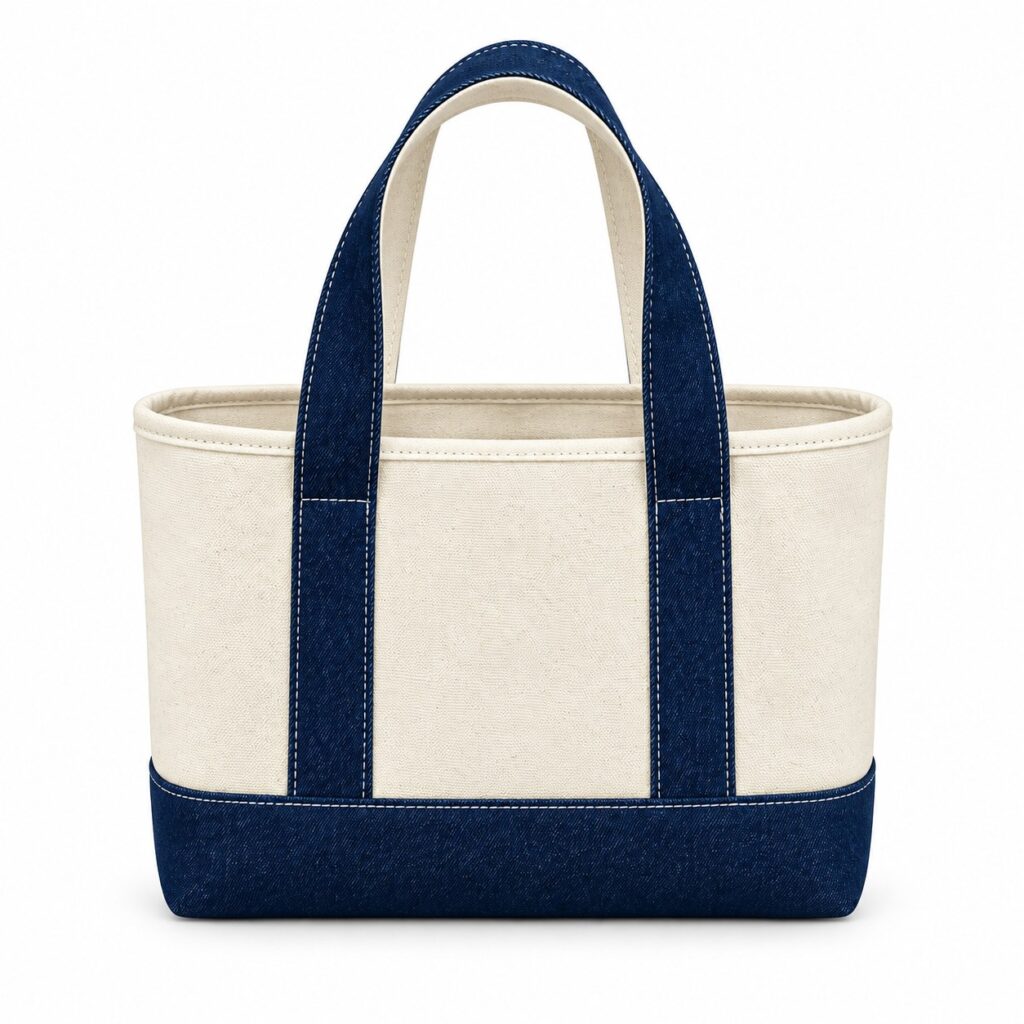
A small botanical drawing repeats neatly on a designer’s screen. On the bag outline, one flower is cut by the base seam and another sits behind a handle. Making the logo bigger would not solve this problem: the whole repeat needs a decision about scale, direction and crop.
For an all-over repeat print cotton tote bag, distinguish the pattern itself from how the bag will be cut, printed and assembled. A seamless artwork tile does not promise a seamless-looking finished bag. First ask the supplier whether a suitable print and construction route can be assessed for the proposed cotton and order.
Approve the repeat unit and the visible motif separately
The repeat unit is the area that repeats; the motif is the drawing or arrangement within it. Record the unit’s width and height in millimetres, then identify the size of a recognisable motif. This stops a screenshot being scaled until the bag is filled, unintentionally changing the illustration.
Adobe’s pattern tutorial explains how tile dimensions, spacing and layout determine a repeat, and how a pattern can be scaled independently of its containing object. For a buyer, the useful takeaway is to approve those choices explicitly, not require the factory to guess them from a flattened preview.
Keep a repeat preview showing several units next to an actual-size motif. Look for unintended stripes, large empty spaces or awkward meetings between neighbouring drawings. Correct the design with its owner before asking for a fabric sample.
Choose a direction that works on the assembled tote
A directional pattern has a clear top. Show that direction on every relevant panel, including the reverse. A folded body construction may place the same continuous design differently from two separately cut faces; ask for a panel drawing rather than assuming the reverse will remain upright.
Choose the repeat on the actual cotton or cotton canvas, not a smooth screen background alone. For a tote intended for repeated use, assess whether the print area leaves the panel pleasant to handle and the pattern still works as the bag opens and folds. Plain handles or base panels may suit the design without adding more decoration; they are options to review, not evidence of a lower-impact product.
Check the handles, gussets and contrasting base separately. The buyer may want them plain, patterned in a different direction or excluded from the proposed print. A photograph of a patterned front does not define those components.
The panel specification guide is useful for identifying the parts. Here the decision is what each part reveals of the repeat, not whether a particular panel construction is stronger or available.
Check seam matching separately from the repeat
A digital tile can join perfectly to itself while cut pieces reveal different portions when sewn together. If the design needs a line, border or particular illustration to continue across a join, describe that as a separate matching requirement for feasibility review.
Ask the supplier which joins can be controlled, how the requirement affects cutting and what sample is needed to show the result. Do not approve a general promise of “all-over print” as an answer to a specific matching request.
Where an exact motif position is unnecessary, say that too. You might approve a random crop within an agreed repeat while excluding a few unacceptable outcomes. State those exclusions clearly, such as cutting an essential word or leaving a recognisable figure incomplete in the main visible area.
Review more than one plausible crop
Place the agreed repeat behind the finished panel outlines at actual scale. Move the outlines to show different possible crops, keeping the same motif size. This shows the design choices; it is not proof of how production will be arranged.
Ask whether the quotation follows an engineered placement or an agreed variable crop. Record how that distinction will be assessed on samples. A buyer should not reject every changed flower position after having approved variable placement.
Keep any border, credit or logo that requires exact placement on a separate annotated view. The print placement guide covers that fixed graphic; do not let it inherit the repeat’s variable-position approval.
Review the repeat on an assembled sample
Request a sample that shows the agreed cotton, print proposal, motif scale and assembled crop. Inspect the opening, base and joins with the bag both flat and opened. A fabric strike-off can help assess colour and repeat size, but it cannot show every result of cutting and sewing.
Record accepted and unresolved points separately. If the motif size changes after sampling, reassess the crop and any matching requirement rather than treating the change as a colour correction. Keep the repeat reference and the approved finished sample linked.
Send Gahumi your repeat unit, actual-size motif, bag panel drawing, crop expectations, quantity and delivery destination. Ask Gahumi to assess the proposed printing, assembly and any seam-matching requirement, then request a quotation for a representative sample.
Email the files and requirements to gzgahumibag@gmail.com.