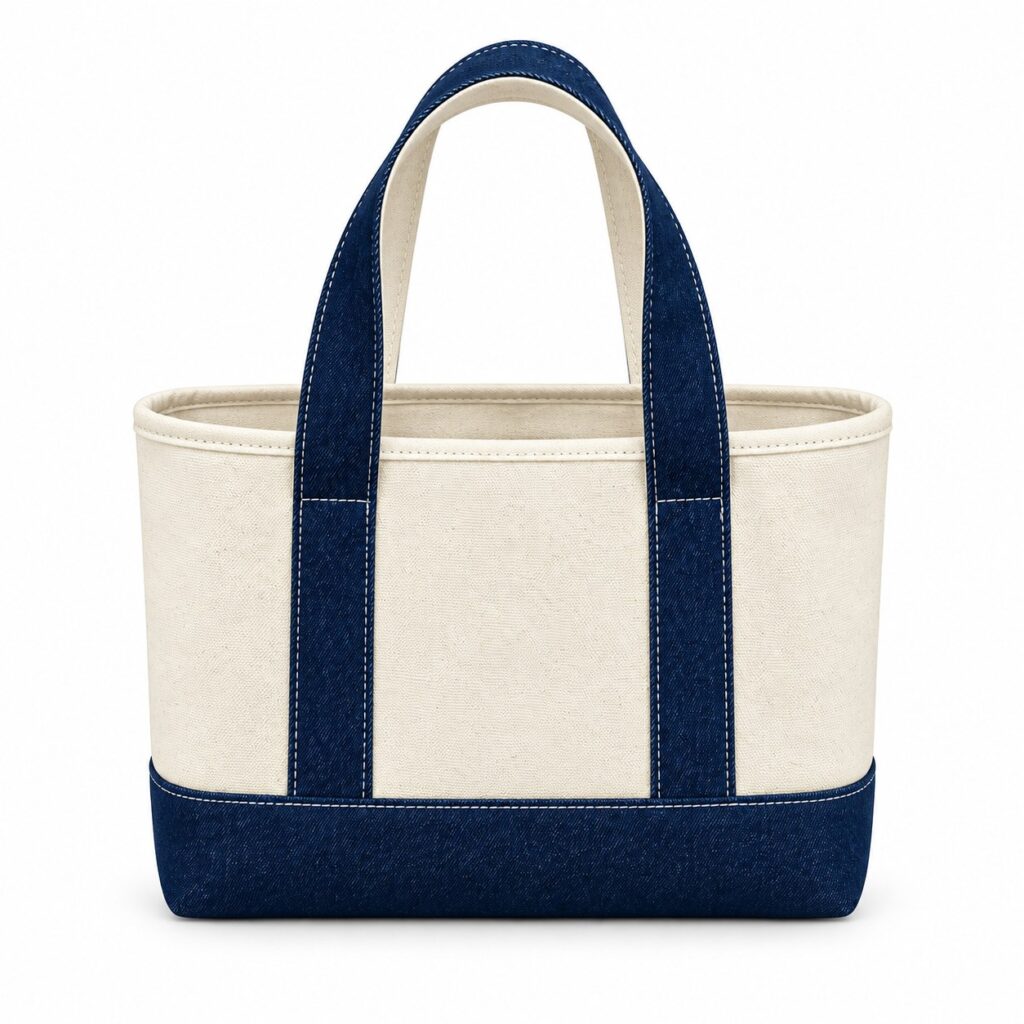
Two people can measure the same tote and report different widths. One measures across the flat bag; the other opens its base. Both numbers may be accurate descriptions of what they measured, but neither is useful to a production team until the method is clear.
For cotton tote bag measurements, define the finished product, its position during measurement and the exact start and end points. Then agree acceptable variation for each important dimension. This gives a retail buyer and a factory something more precise than a photograph with three numbers beside it.
Measure the finished bag, not just the cutting pattern
A pattern dimension includes decisions that disappear into seams and hems. Ask for dimensions of the completed bag unless the drawing is specifically a manufacturing pattern. Keep these two records separate so a cutting measurement is not copied into a product listing.
Place an empty sample on a level surface without pulling it into shape. Note whether the gusset is folded or opened, whether the top is closed and whether the handles are lying flat. If a different position is needed for a particular measurement, show it in the drawing.
Gahumi’s patchwork tote specification guide covers the wider panel layout. The measurement record should focus on the finished points that will be checked against that layout.
Give each dimension its own reference points
“Width × height × depth” is a useful summary, not a complete instruction. A wide top and narrower base need separate entries. A curved opening also requires an agreed reference rather than an assumed straight edge.
- Top width: identify the finished points across the opening and whether the bag is flat.
- Body height: define the top edge and the base line; exclude handles unless stated otherwise.
- Base dimensions: show the base opened, with its width and front-to-back depth separately marked.
- Handle drop: identify the opening reference and the highest inside point of the lifted handle.
- Pocket and print positions: measure from named finished edges or seams, not from the centre by eye.
Give each point a simple code on the drawing. A photograph labelled W1 is easier to match to a record than several arrows all described as “bag width”. Use centimetres or millimetres consistently and write the unit beside the values.
Agree tolerances where fit matters
A tolerance is an agreed range around a target, not a general permission to change the bag. Discuss it before approving the sample and quotation. Do not import a number from another product or assume every measurement has the same allowance.
Begin with the use. A catalogue that barely fits through the opening may need a closer review of that opening than a decorative panel does. Explain which dimensions affect access, display or packing, and ask the supplier to assess the proposed limits for the chosen construction.
Record lower and upper limits explicitly. If several dimensions must work together, approve the assembled result as well as the individual numbers. A bag can meet a width target yet still be awkward to use because the opening or internal obstruction was overlooked.
Use a repeatable measurement sheet
The following fields make a practical record. Add as many points as the design needs; this is a record structure, not a prescribed inspection standard.
- Style code, drawing version, sample reference and date.
- Measurement code and photograph showing the endpoints.
- Bag position, measuring tool and unit.
- Target, agreed lower limit and agreed upper limit.
- Actual result, observation and person recording it.
Ask another person to repeat a few measurements using only the sheet. If they need verbal clarification, improve the instructions before using them for bulk checks. Keep photographs square to the measurement where possible; perspective can make a tape appear to show a different value.
Separate original size from changes after care
Label measurements as unwashed or taken after an agreed care procedure. Mixing those states makes a comparison unreliable. Cotton content alone does not establish a finished bag’s dimensional stability, particularly where different panels, print or trims are involved.
If cleaning is part of the intended use, link the record to the sample and procedure in the finished-bag care review. Keep the original measurement method unchanged when comparing results.
Send a drawing that can be checked
Send Gahumi your annotated drawing, intended contents, target dimensions, quantity and delivery country. Highlight any close fit or preferred measurement limits. Ask which sample checks and inspection arrangements can be agreed for the project before confirming the order.
Prefer email? Send your brief to gzgahumibag@gmail.com.